
Sleeping on Soybeans
Week 29 Weather, Ags, & Macro

“Every gun that is made, every warship launched, every rocket fired signifies, in the final sense, a theft from those who hunger and are not fed, those who are cold and are not clothed.”
— Dwight D. Eisenhower
Beans are bearish at $11.30. China isn’t buying enough.
Beans are definitely bearish at $12, the farmer’s selling, O/I’s up 200k. See I was right.
Beans will fail at $12.50, this triple top is a wall. The weather’s really good, didn’t you see “so and so’s” yield projections.

I’m giddy again. It’s probably time to get nervous. You’ve been warned. In this week’s note:
Cute vs Making Money
Upcoming Global Weather Risks (Week 29)
Bean, Beans, the Magical Fruit — an exciting analog
MOAR Protectionism, an update on Tariffs
CoF & the Border Opens. Is there a China Trade deal?
Black Sea is way too complacent, and short/long-term views
Cute vs Making Money
Yield forecasting has been standard industry practice since long before I began. Possibly before I was born. We used to take the time to do this — predicting what the USDA would release each month.
Traders waited for government reports because stocks and production data were considered absolute gospel.
This is how it was. For many, this is how they still think it is.
The U.S. also used to grow oranges. How much things change.
I have had more than one subscriber recommend that we publish production forecasts to get our name on Reuters and Bloomberg wires.
This is not happening.
The U.S. was once the world’s global pricing benchmark, the residual holder for physical stocks, and the primary exporter. It made sense that the world hung on its every forecast.
Then the paradigm radically changed in two critical ways:
China became a dominant pricing driver because the world’s physical stocks shifted East. We see the exact same dynamic in energy.
The U.S. is no longer a low-cost commodity producer. In many cases, it is completely uncompetitive. Russia, Brazil, Argentina, Indonesia, and Ukraine arrived.
The USDA’s role is far less dominant today in grains, orange juice, rice, and cotton, though it remains relatively important for policy-driven domestic industries like soybeans. Many traders and analysts haven’t put this together yet—and the systematic, trend-following crowd simply doesn’t care.
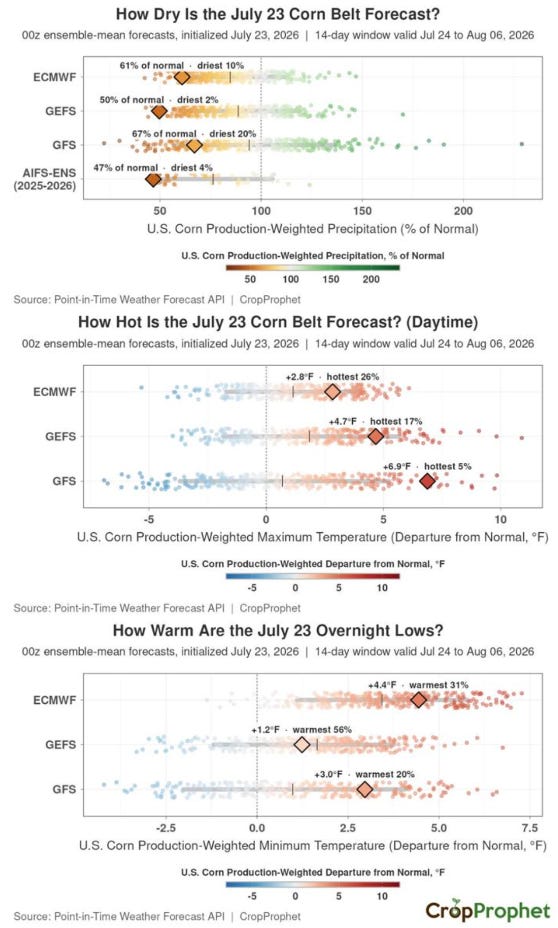
Weather groups began releasing their yield forecasts this week, and they are a doozy.
The reason we will not participate in this time-honored industry tradition of guessing what the USDA will say is simple: it won’t make us or our subscribers a single dime.
These weather groups do an excellent job tracking and visualizing weather, and I very much enjoy their work. But playing the report-guessing game is a distraction from where the real market edge actually lives.


This one from Crop Prophet was shared with me. If I wanted to quickly understand a point in time, this is great. It catches the eye, with all the forecasts worth tracking right there.
I had a very successful old, retired trader (emphasis on old because he’ll hate it when he reads this), who beat into me when I first started working with data:
“Is it gonna be cute, or is it gonna make money? It can’t be both.”
You judge for yourself.
AiQ went 10/10 bullish more than a week ago, while weather groups are out here forecasting record yields.
It can’t be both.
Yes, for anyone wondering, it’s nerve-wracking to have gotten this bulled up after the May/June commodity massacre. That’s the beauty of having the data, it doesn’t remember.
Which one is it? It can’t be both.
Weather Risks — Week 29
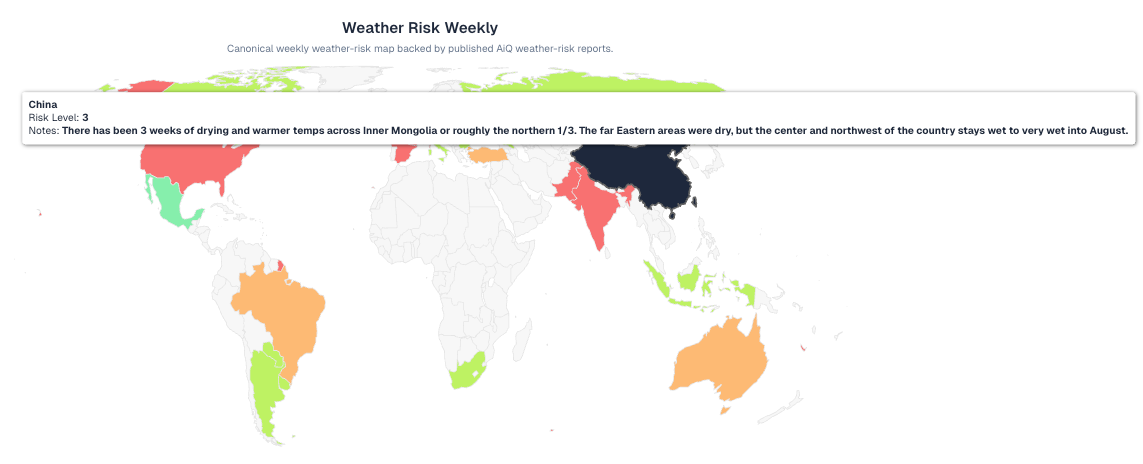
Before we dive into the USA forecast, since that’s all that matters for the next two weeks, let’s touch on a few weather events to have on your radar.
