
IOUs
Those are as good as money. The USDA March 31st Preview

"Free is the most expensive way to get something."
— Jewish Proverb
Let’s establish a quick baseline. There is no “Kpler” in agriculture. For those unfamiliar with the energy industry, Kpler is the gold standard for logistics, stock data, and analytics.
In 2014, the collaborative vision of engineers François Cazor and Jean Maynier ignited a journey towards revolutionising trade through the power of innovative data technology.
For anyone who’s been around agricultural trading or just casually perusing information on the coattails of the developing fertilizer and commodity investment story, here’s how most of the agriculture “research” works.
Most wires are funnels to drive brokerage business. They want you to trade, so they give away the information. Some of the more recent telegram channels and websites are scraped sources aggregated for free at the price of a ☕. Most of them never change their tunes. This creates two types of ag IOUs. Neither of which AiQ will ever offer.
IOU —> I give you this newsletter for free, you owe me order flow.
IOU —> I was wrong the last 6 months, and I owe you better advice.
At AiQ, we don’t care if you trade. We’ll cheerlead your 401K bets on the CORN ETF or punting cotton futures in your IBKR account. If you benefit from the knowledge of a human broker, even better. Our products will be the best and cheapest. Evolve as quickly as the market and price action demands. That’s the point of technology. Better and more affordable. Amirite?
More and more, subscribers are asking for my thoughts about other people’s narratives and trade ideas.
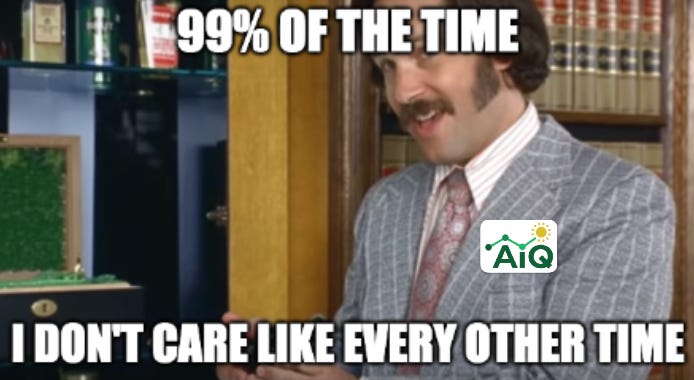
We get the same wires as you do. We know the Shticks of the FERPs. It’s a small industry. Every few months, some new group promotes an AI solution or secret balance sheet sauce—tries to charge 6-figures. Then their prices collapse.
It’s never worth it —> 100% of the time.
To say I am skeptical of the quality of work out there would be the understatement of 2026. The USDA is the most heavily resourced organization in the world, and we have been a leader this year by routinely fading the government reporting.
We cover a number of topics in the video, but I want to touch on one in particular. At the 36-minute mark, Benny asks about “trading against specialists,” implying it must be hard to make money because grain traders are so knowledgeable about the specifics of each commodity.
The reality could not be further from the truth.
Most ag companies and individual traders take far less speculative risk than at any point since I entered the business. Poor performance reigned in risk-taking prior to the pandemic. I ascribe this to two causes.
A failure to adapt to how systematic trading has changed markets
Catastrophic groupthink
I am miffed that organizations attempting to attract traders and companies accept this as “agriculture expertise.”
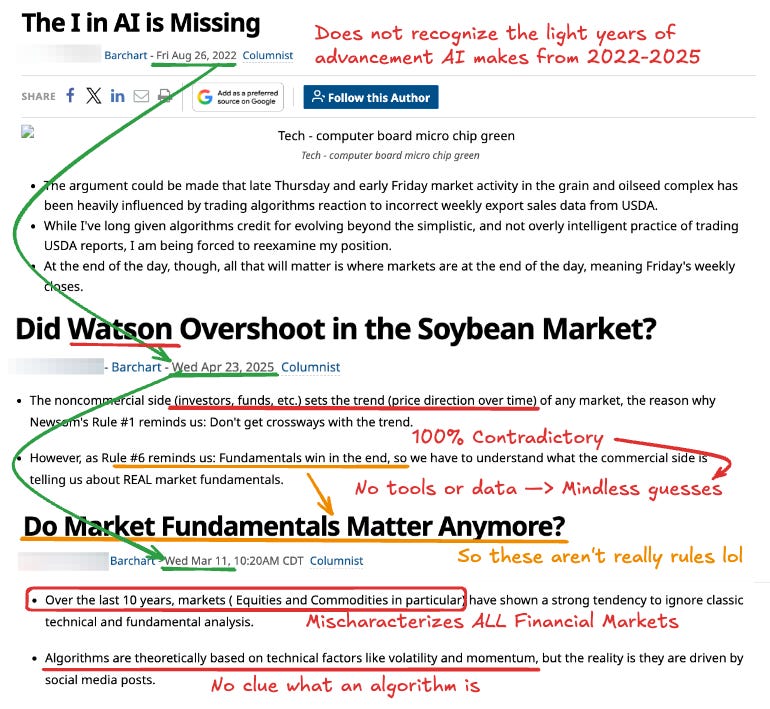
Remember, some variant of systematic trading accounts for the majority of daily volume, while hedgers still make up the majority of open interest. This is a big difference, and we will roll out tools to better quantify this.
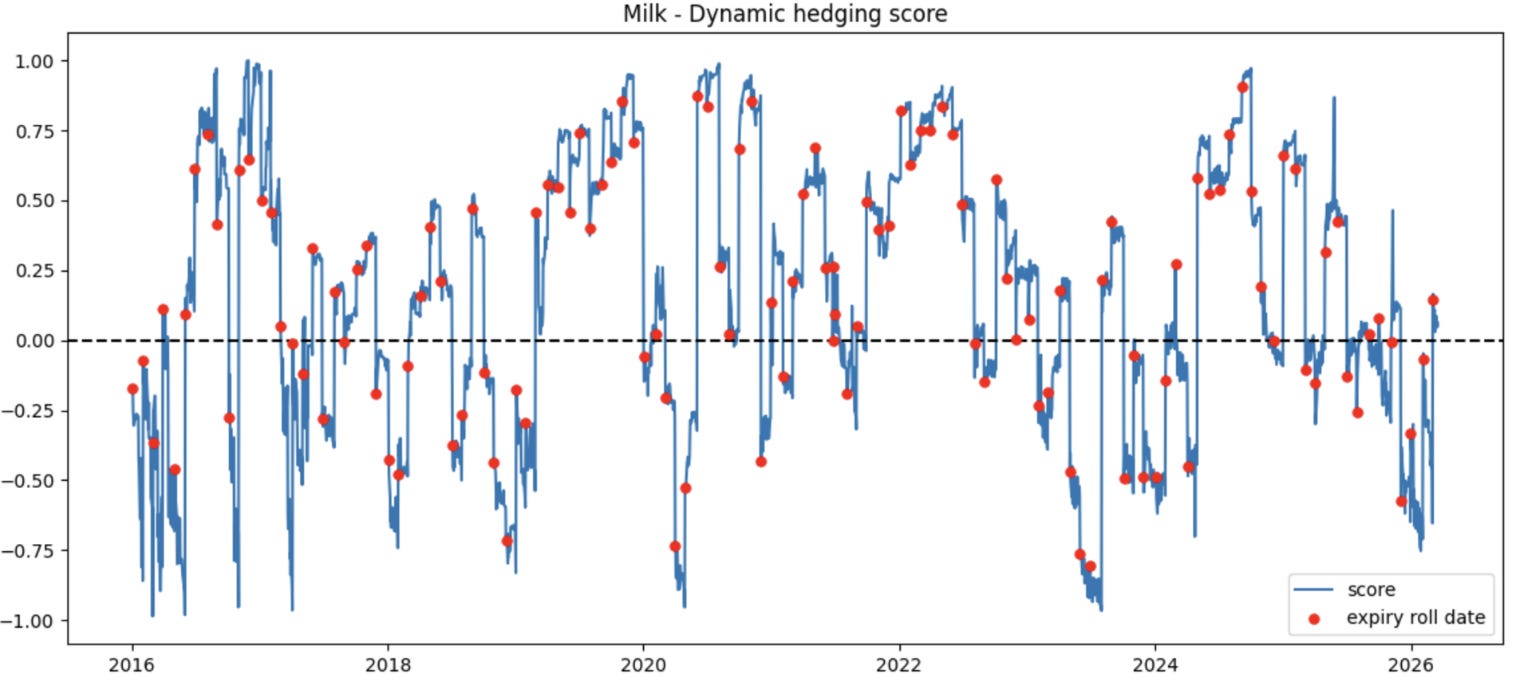
If hedgers, who already have money sitting in their margin accounts, could make more money trading, they would trade more. I hope it’s clear why we don’t put weight into what most of these newsletters say.
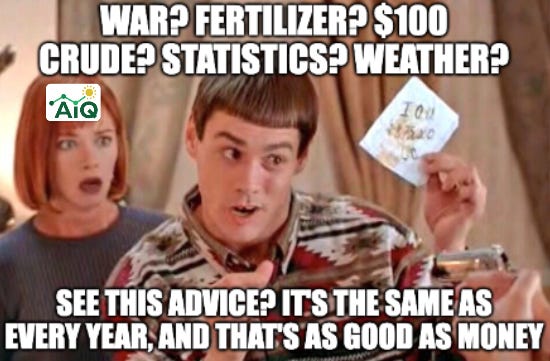
In the spirit of the legacy ag research IOUs, let me introduce a new rule.
AiQ Axiom:
When Legacy Newsletters Agree, Take the Other Side
I don’t normally tease stuff, but I found out that we have an extremely rich data history that I was completely unaware of. We will turn this into a fantastic interactive tool. More on this below.
You could say I found my bubbles for the day.
USDA March 31 Preview of Planting Intentions
I heard today that a notable group is above 96 million corn acres and 181 combined corn and soybean acres. This is definitely the high end of the range. They indicated confidence in these figures.
