China Week
Tour-de-Ag May 11, 2026

"A good compromise is when everyone gets something they don't want."
-Calvin and Hobbes
It’s May 11. “China Week” is upon us.
This is pretty funny and shows the 180-degree change across global ag markets. I had forgotten one of the passwords for an email inbox where I get various industry newsletters:
SellWheatLiveInMansion$$
How funny is that? Yeah, that one definitely needed updating lol
Key Themes for the Week:
The Farm Economy Struggles
Cotton: My Favorite Anecdote Right Now
China Trade Deal Week Arrives: It Could Be Big
Argentina’s Problems Are Getting Masked
If you are new to agriculture or have been in the business for 40 years, there is a single, critical point you need to learn or remember: Everyone relies on the same data, and it is backward-looking. It’s useful only in the sense that the lead/lag nature serves as a rolling signal, but the Sharpe ratio is non-existent.
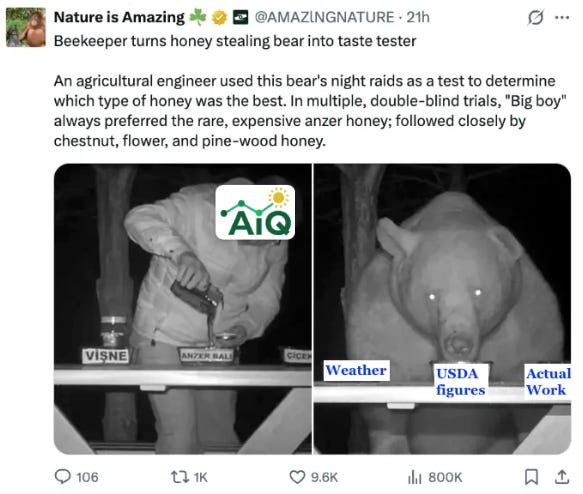
AiQ uses this information as an active heuristic: Will wheat be $7, $8, or $12? It will happen when the industry journalists are writing about the cushion shrinking. Don’t forget this.
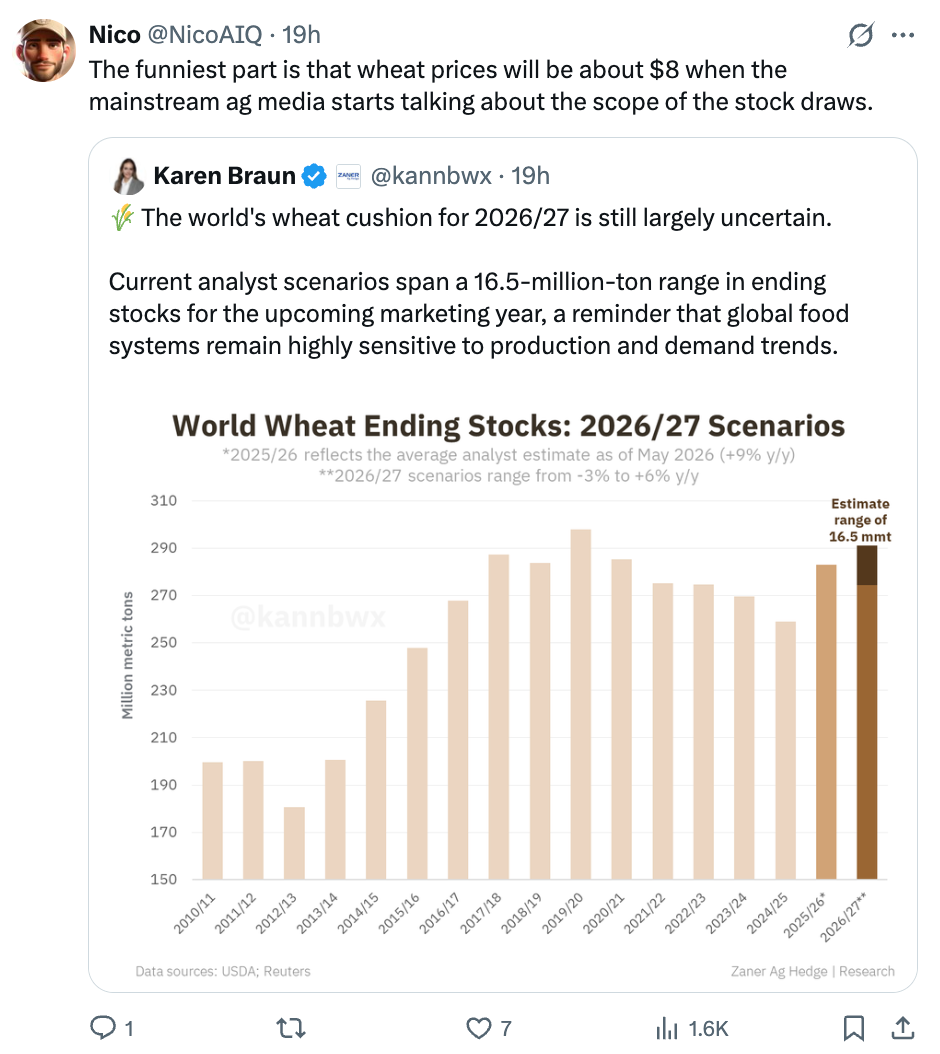
There is no wheat cusion at $5.50 wheat. It’s gone. Farmers around the world cannot plant and fertilizer “wheat the weed.”
Don’t take it from me, take it from the man himself.

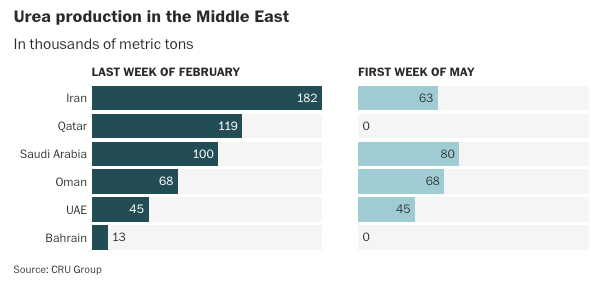
In Thailand, the Philippines, Bangladesh and Australia, which are the first since the war to enter key sowing periods, farmers are choosing to skip or reduce planting, or cut fertilizer use, which will lower yield…
Heading into planting season, many farmers said they are facing the worst conditions in their lifetimes. Not during the outbreak of the Russia-Ukraine war were shortages or costs this dire, they said. Nor during the pandemic.
Nam Aoi, 58, said she can only afford to plant on 19 of her 32 hectares. Until now, she never left farmland barren before.
I love this survey. It perfectly highlights this administration’s populist struggles. Anyone still using the word TDS as a putdown is a few sandwiches short of a picnic.

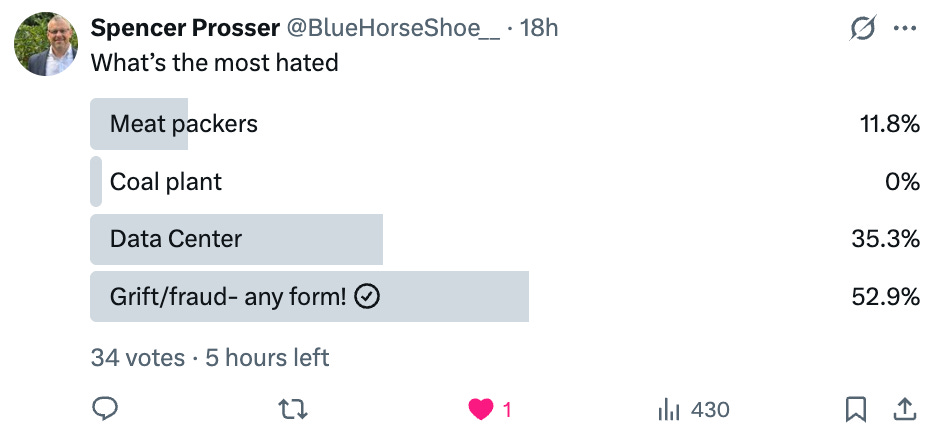
Attacking the meatpackers will be popular across the agricultural community because of what these “cartels” represent, but it will not change behavior. It will also backfire—and we are putting on trades around that.
The timing is horrible, as packer margins will average a negative $100 per animal for the rest of 2026. They are roughly -$300 today. Ranchers are making a lot of money on paper, but the reality is much worse because of how expensive one-day-olds have become.
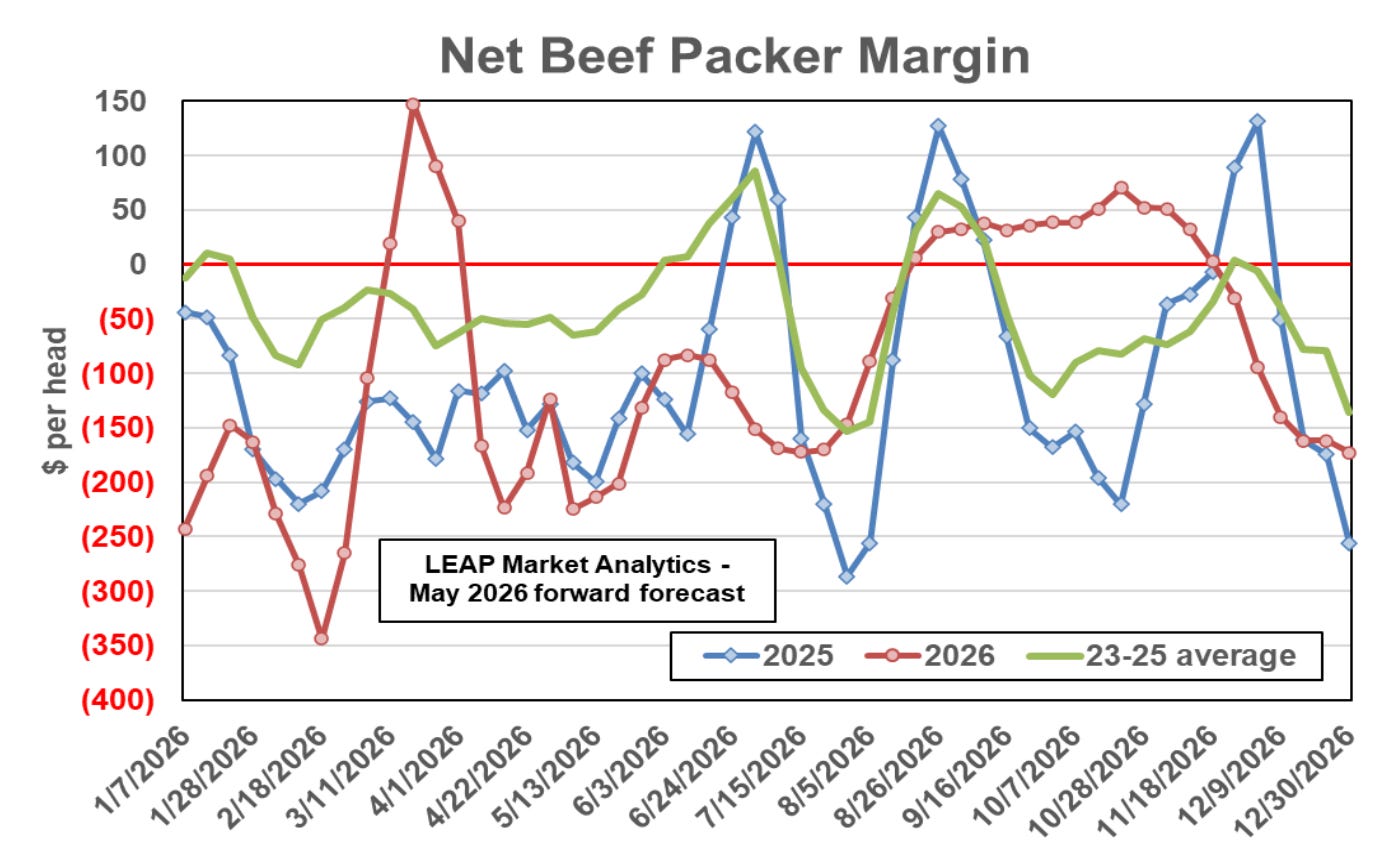
I spoke with one of the most efficient operators in the nation this week, and they won’t pay these prices for a calf. It is simply not worth the risk. We will continue to buy more puts with a clear understanding that—without more government intervention and more and more imports—there is no good solution.
The “Golden Era” for America somehow became the Nasdaq at a bazillion and everything made somewhere else in the world because it’s more cost-effective—except for the bombs Israel will drop. Don’t come at me; I don’t make the rules.
The litmus test for prices needs to be this simple: “If farmers can’t make money at $4.50 corn, prices need to go higher.” There are only three ways to make money at $4.50 cash corn:
inputs come down,
yields are astronomically huge, or
Trump gives farmers so much money that planting the crop becomes a byproduct.
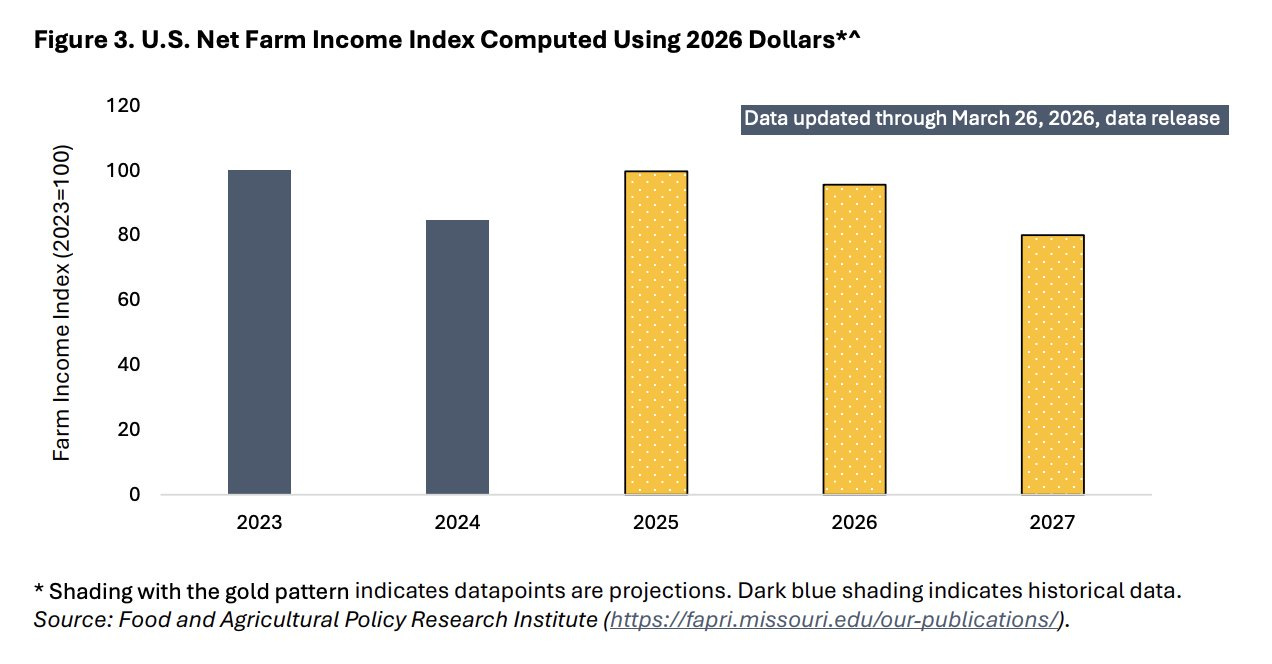
Every data point, from producer sentiment to machinery sales, confirms this. Don’t complicate it.


Totally tangential, but we are entering the “bubble phase” in America. I am not long the Nasdaq, which makes me the “dummy” for now, and I am perfectly comfortable with that.
The reason I bring this up is that it dovetails into my point below on Argentina. There will be a few trades here—a few big ones. We are talking about the asymmetric, “take a year off and travel the world” type of trades, but they are still a ways off.

A quick thank you:
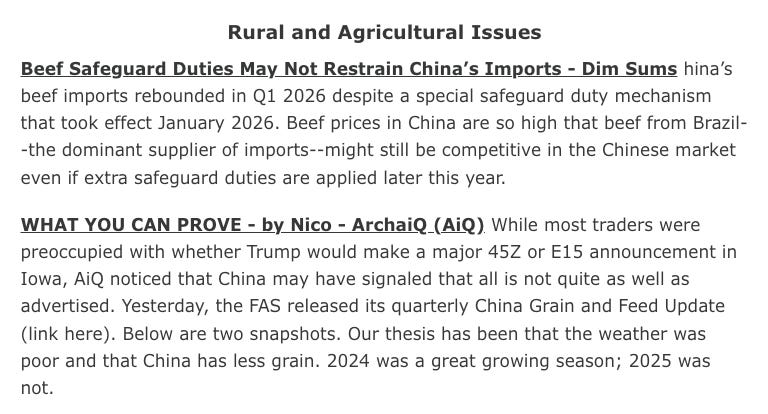
Trump will go to China next week to one-up his previous “Greatest Trade Deal” from January 15, 2020. We covered this and more in our Trump-Xi meeting preview. Bill cited our work, and the Dim Sums article brings up some interesting points about the state of farming in China. The pieces continue to fall into place.